Creative Commons License
This work is licensed under a Creative Commons Attribution-Noncommercial-Share Alike 2.5 License.

Thursday, May 24, 2007

Reflections on blogging the override

Blogging the information on the override was fun. I learned a whole lot about Proposition 2 1/2. About town government. About town finances. About the school budget. About the workings of our government.

Franklin is not a very online community. The student population is much more online than the adult population. The primary exposure of the adult population to online activity is email. They can follow a link in an email but are not sophisticated about RSS feeds, commenting on blogs, and other similar activities.

The town does have an online forum but it seems to be limited to a small group. The forum allows anonymous profiles which does not foster a real good conversation. I hesitated to join but while I have tried to obtain access, several attempts are still pending acknowledgment.

There is a good opportunity to use Web 2.0 tools like blogs, social network sites (Facebook, etc.), and to enable a healthy discussion amongst identified individuals in Franklin's future.

Labels: , , ,

Tuesday, April 10, 2007

Toasters on Innovation

From the Sunday edition of the Boston Globe Business section comes a good article on innovation as a process and not an end result.

In a recent issue of The MIT Sloan Management Review, Michael Schrage, a business writer and a Massachusetts Institute of Technology researcher, challenged the thinking of a prominent Columbia Business School professor. More specifically, he challenged what Bruce Greenwald, whose work focuses on finance and investing, has said about the fate of all innovative technologies: "In the long run, everything is a toaster."

That is to say, even the most impressive breakthrough eventually becomes mundane, with all producers offering more or less identical versions of the same item and competing largely on the basis of price: Innovation runs its course, and the thing becomes a commodity.

Schrage's article, "The Myth of Commoditization," argued that not only is this not true of technological breakthroughs, it's not even true of toasters. "Heated bread lacks the high-tech cachet of multicore processors or polymerase chain reactions," he wrote, but the "technical evolution" of toasters offers a "case study in profitable innovation."

Read the full article here.

I had not heard of

The Back to Basics Egg & Muffin Toaster seems to offer good evidence . With a retail price of around $40 (double the typical price of a plain toaster), it was a top-selling toaster in 2006, and that seems to be largely because of what makes it distinct . As the name implies, it's a toaster with a built-in egg poacher.

...

Melissa Clyne, a spokeswoman for the company, says the Egg & Muffin Toaster was a result of one of the company's regular brainstorming sessions in 2005. In this case, someone brought in an egg poacher, and after some discussion the idea was has hatched to mush it onto a toaster. "It gives the toaster some added functionality," she explains. "We have a lot of folks out there who are multitasking."

Labels: , ,

Wednesday, April 04, 2007

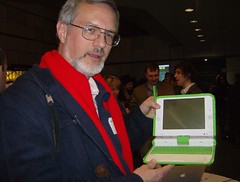
Yes, it is the $100 laptop


Yes, it is the $100 laptop
Originally uploaded by
shersteve.
The One Laptop Per Child (OLPC) project uses a wiki to provide information and updates.

It's an education project, not a laptop project.

— Nicholas Negroponte

I was fortunate to hold one when I went to MIT for the BeyondBroadcasting Conference. Pretty slick devices. They have re-engineered the laptop for a child to use in the 3rd world.

I can hardly wait for some of the enhancements to make it into mainstream laptops.

Read more about OLPC here at their wiki.

Labels: , , ,

Monday, March 12, 2007

Stata @MIT

The Boston Globe had an article reflecting on the first three years of the Stata building at MIT. I had my first opportunity there as part of the BeyondBroadcasting 2007 event which was held a couple of weeks ago.

You can read the full article here.

I would add that I was impressed with how the mix of old and new helped the building work. The new space arrangement, created odd places along the main 'street' which enabled conversation to just happen as folks gathered. The 'old' technology, chalkboards and big pieces of what we would have called sidewalk chalk were in use to draw out diagrams or the line of thought on boards along the 'street'.

Virtual chalkboards, workspaces are cropping up in the online community to enable collaboration in the internet for folks scattered about the world. But the real chalkboard still has a place where people do gather. An alternative to the chalkboard, the whiteboard with erasable markers was oddly not prevalent in the 'street'.

Labels: , , ,